
The Brain, the Body, and the Hands: How Modern AI Agents Actually Work
$7.84 Billion
AI agent market size in 2025
$52.62 Billion
Projected market size by 2030
86%
of C-level executives say AI agents are strategically important
57%
of companies already have agents running in production
Source: Creatio 2025; G2 Enterprise AI Agents Report 2025
Why Everyone Is Talking About AI Agents
The phrase ‘AI agent’ has become one of the most used, and most misunderstood, terms in business. Ask ten people what one actually is and you will get ten different answers. Most, if pressed, will admit they are not entirely sure.
This confusion is costly. Without a clear mental model of what the technology does, you cannot make sensible decisions about when to use it. You either dismiss it too early or adopt it without understanding what you are building.
This article closes that gap. We use a simple framework — Workflows, Agents, and Tools (WAT) — to explain how AI agent systems are structured, what makes them different from the automation tools you already know, and what to consider before building your first one.
The Automation You Already Know — And Its Limits
Traditional automation — tools like Zapier, rule-based scripts, or RPA bots — follows a simple logic: IF this happens, THEN do that. It works well for structured, predictable tasks: sending a confirmation email, moving a spreadsheet row, routing a support ticket.
The problem is that most business processes are not fully predictable. Traditional automation breaks down when it encounters:
- Unstructured data — emails, PDFs, freeform text, voice notes
- Ambiguity — situations where the right action depends on context
- Exceptions — edge cases no developer anticipated in the rules
- Multi-step reasoning — tasks that require planning and adjustment
The Brittleness Problem
A rule-based invoice bot works perfectly until a supplier changes their format. The bot fails, invoices pile up, and someone has to manually fix the rules. This is not a bad implementation, it is an inherent limit of rule-based systems.
What Is an AI Agent?
An AI agent is a software system that can perceive its environment, reason about a goal, plan a sequence of actions, use tools to execute those actions, and adapt when things change, all with minimal human intervention.
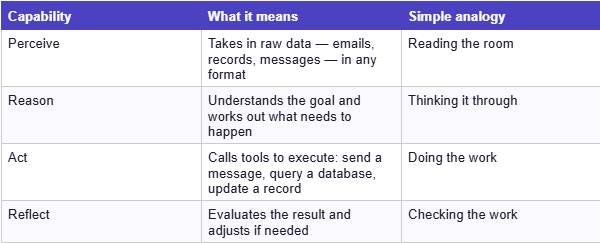
At its core is a Large Language Model (LLM), the same technology behind ChatGPT and Claude, which acts as the reasoning engine. Around it are four capabilities:
The key distinction
A chatbot answers questions. An AI agent takes actions. A chatbot tells you ‘here are five hotels in Cape Town’. An AI agent finds the best option, checks availability, makes the booking, adds it to your calendar, and sends the confirmation, without being prompted at each step.
73%
of repetitive business tasks can be automated using current AI agent technology
6 - 8x
faster execution of routine workflows compared to manual human processing
24/7
operational uptime — AI agents don’t sleep, take leave, or lose power during loadshedding
The WAT Framework — Workflows, Agents, and Tools
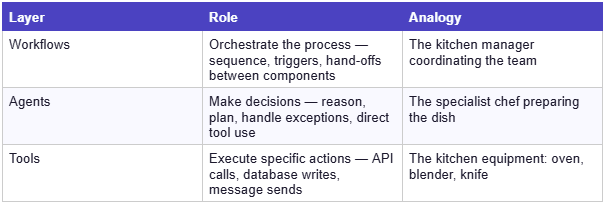
Real-world AI systems are not a single agent — they are composed of multiple components working together. The WAT Framework gives you a clear mental model of how they are structured.
Workflows: structure and sequence
Workflows define how the system behaves: what triggers it, what runs in what order, and how data flows between components. Platforms like Make.com and n8n are workflow tools. They are the plumbing of the system.
Agents: intelligence and judgement
Agents are the intelligent components within the workflow. Each has a specific role — qualifying a lead, drafting a response, analysing data — and is powered by an LLM with instructions defining its goal and the tools it can use. This is where human-in-the-loop approval gates live: checkpoints where a human reviews a proposed action before it is executed.
Tools: execution
Tools are the functions agents call to interact with the real world: database queries, WhatsApp messages, calendar entries, spreadsheet writes. They are modular and reusable — the same email tool can be used by three different agents across the same system.
Human Oversight. Non-Negotiable by Design
A well-designed AI agent system has human-in-the-loop gates at every high-stakes decision point — before any outbound client communication, financial commitment, or irreversible action.
The practical approach is graduated autonomy: agents run freely on low-risk, reversible actions, and require human approval on anything that matters. As you build confidence in an agent’s performance, you can progressively relax those gates.
The Agentic Studio Principle
Every system we build includes human review gates on all outbound client communication. Agents draft and propose, humans approve and send. Automation handles the volume; humans maintain the relationship.
Three Questions Before You Build
1. Is the task dynamic or static?
If the process always follows the same steps, traditional automation may be sufficient. AI agents add the most value in tasks involving variability, judgement, or unstructured data.
2. What is the cost of an error?
AI agents, like humans, make mistakes. If the cost of an error is low and reversible — a draft that gets edited — agents can run with high autonomy. If the cost is high, ensure robust human review gates are in place.
3. Does it work within your existing tools?
The best agent systems build on top of tools your team already uses — they do not replace them. If your team works in Google Sheets and WhatsApp today, your agent system should too.
The WAT Framework, Workflows orchestrate, Agents decide, Tools execute, gives you a practical lens for understanding any AI automation system. With it, you can ask better questions, evaluate proposals more critically, and build systems that genuinely fit your business.
If you want an honest assessment of where AI agents can add real value in your operations, Agentic Studio offers a free Automation Audit, no jargon, no sales pitch, just a clear mapping of your workflows and a practical recommendation.